




LOS ANGELES—An OnlyFans marketing and management company sued three of its former adult content creators for violating portions of an agreement stipulating that the firm has ownership over any content the models post and monetize on their accounts.
The company is Nova Marketing LLC, a Delaware-registered entity wholly owned by a supposed nonprofit organization known as the Horizon Solara Foundation, which appears to be a registered entity in Panama. Attorneys for Nova sued three women, all based in Brazil, for simply sharing images they produced outside of the purview of the agreement.
The stage names of the three defendants are Isabella Santos, Vitoria Alves and Rafaela Santos.
Filed before the U.S. District Court for the District of Delaware, all three cases signal a noteworthy legal development as the creator agency space matures in both the mainstream and adult content arenas. The three suits additionally raise questions over contracts and ownership of likeness, like content produced by the adult creators depicting sexual acts.
"This is an action for copyright infringement of certain foreign copyright works ... seeking damages and injunctive relief," reads the lawsuit against the creator Vitoria Alves. "Nova owns all right, title, and interest to certain foreign copyright works created and published by its content creators outside the United States."
Attorneys representing Nova in all three suits are partners at intellectual property law firm Panitch Schwarze Belisario & Nadel LLP, which has offices in Delaware and Pennsylvania. In the court filings, Nova's attorneys allege that the three performers violated a content creation and copyright assignment agreement with the company.
All three of the agreements have provisions that ultimately assert Nova's claims of intellectual property and copyright ownership of content featuring a model's image and likeness.
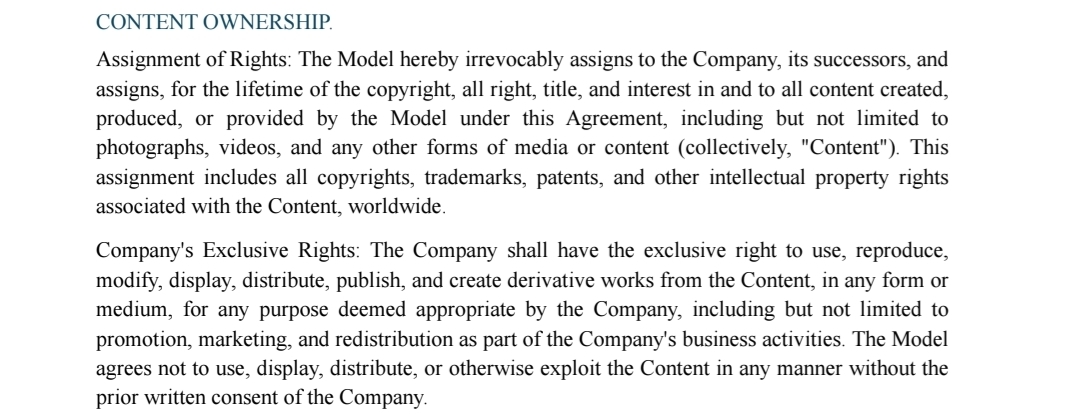
The agreement states, "The model hereby irrevocably assigns to the company, its successors, and assigns, for the lifetime of the copyright, all right, title, and interest in and to all content created, produced, or provided by the model under this agreement, including but not limited to photographs, videos, and any other forms of media or content."
Under these form agreements, the content is owned by Nova Marketing in perpetuity. In the complaint for the case mentioned above, Nova's attorneys maintain that the "[defendant] began distributing photographs, videos, and other forms of media and content generated pursuant to the copyright agreement and published on defendant's OnlyFans accounts to third parties in express violation of the copyright agreement."
These alleged violations happened as recently as March. Three photos were attached to the lawsuit against Alves, which Nova alleges to be clear violations of the agreement. The images could be considered "lifestyle" and "safe-for-work," and there is no indication as to whether these images were ever behind a paywall or available for purchase through her OnlyFans page.
The agreement is written so that the model under Nova Marketing management would have to obtain approval before distributing any copyrighted content, regardless of the type of content being shared. Attorneys for Nova note in the Alves complaint that they "identified defendant's infringing use of the works, specifically the unauthorized distribution of media and other content published on defendant's OnlyFans accounts to third parties."
There is no indication of what "third parties" means, but the alleged infringement was on the OnlyFans platform, where Alves created three accounts for her free and premium distribution of material that Nova claims it owns via the copyright agreement.
The lawsuits are worded precariously and broadly. In all three legal complaints, the attorneys for Nova indicate that the defendants violated the content ownership provisions of the copyright agreement by way of activity on one or more of each respective creator's OnlyFans accounts. However, there is no clear indication of how this activity constituted the alleged violations of the model contract.
The agreement explicitly outlines what could be construed as predatory provisions for the creators. For example, it states that "[the] model agrees not to sell, license, or otherwise provide the content to any third parties, including other agencies, without the express written consent of the company (Nova). This prohibition includes any use of the content that directly competes with the company's business interests or could potentially harm the company's exclusive rights to the content."
"The company shall have the sole and exclusive right to enforce copyright violations against unauthorized use of the content by third parties," the agreement adds. "In the event that the model becomes aware of any such unauthorized use, the model agrees to promptly notify the Company and provide all necessary assistance to the company in enforcing its copyright and other rights."
The agreement additionally mandates that models agree to a non-competition clause and representation exclusivity. Other details in the agreements indicate that the models were paid weekly fixed salaries ranging from $150 to $500. Justifying the wage amount, the agreement notes, "This fixed salary compensates for all content creation tasks completed by the model in accordance with the weekly tasks assigned by the company.
"The model understands and accepts that the company may receive income from the use, distribution, or monetization of the model’s content, and that such income may exceed the compensation paid to the model," it adds. "The model expressly agrees that they are not entitled to any share of such additional revenue, unless otherwise stated in writing." Also under these agreements, Nova owns the platform accounts, credentials and usernames.
Enforcement of the contract included Nova filing copyright notices to OnlyFans through DMCA Force, a takedown agency based in San Diego. DMCA Force issued takedown demands in all three cases, referring to both images and accounts still featuring the branding and usernames that the creators used to establish a digital presence.
Adult industry attorney Corey Silverstein of Silverstein Legal told AVN that he is alarmed at the lawsuit and the copyright agreement.
"Social media influencers should never sign any type of written ‘model management agreement’ or creator representation contract without first consulting experienced legal counsel," Silverstein said in an email to AVN. "Many of these agreements contain extremely broad exclusivity provisions, long-term commission obligations, intellectual property assignments, restrictive termination clauses, and revenue-sharing terms that can significantly impact an influencer’s future earning potential and control over their own brand.
"Far too often, creators sign these contracts without fully understanding the legal consequences, only to discover later that they have limited their ability to work independently or collaborate with other agencies, platforms or brands," he continued. "A properly negotiated agreement can make the difference between a productive business relationship and long-term legal and financial problems.”
Additionally, an individual familiar with this litigation told AVN that the contracts were not made available in the models' native language of Portuguese.
Attorneys representing Nova did not return AVN's request for comment by the time of publication. Litigation is ongoing, as the three cases were filed in March and April.
Two of the cases are before the same judge, Maryellen Noreika, and another is before Richard Andrews, both Delaware federal judges.
